How to Reconstitute a Lyophilized Peptide in the Laboratory
In short. Reconstituting a lyophilized peptide involves slowly adding a sterile solvent along the side of the vial, without ever pouring it directly onto the powder or shaking the vial. The resulting concentration is the mass of the vial divided by the volume of solvent added. The solution should then be stored in a cool place, protected from light.
Why is it necessary to reconstitute a peptide?
A peptide is delivered lyophilized, meaning it has been dehydrated by sublimation under vacuum. In this form, it can be stored for months. In solution, it degrades within days or weeks due to hydrolysis of peptide bonds, oxidation, and aggregation.
Freeze-drying is therefore a compromise for preservation, and reconstitution is the mandatory step that precedes any experimental work. It is also the step where the most batches are lost, almost always for the same reasons.
Warning. This page describes the preparation of a stock solution in the laboratory for in vitro research purposes. The compounds in question are not intended for human consumption, veterinary use, diagnosis, or treatment.
Which solvent should you choose?
There are three options, and they are not interchangeable.
| Solvent | Composition | Use | Shelf life after opening |
|---|---|---|---|
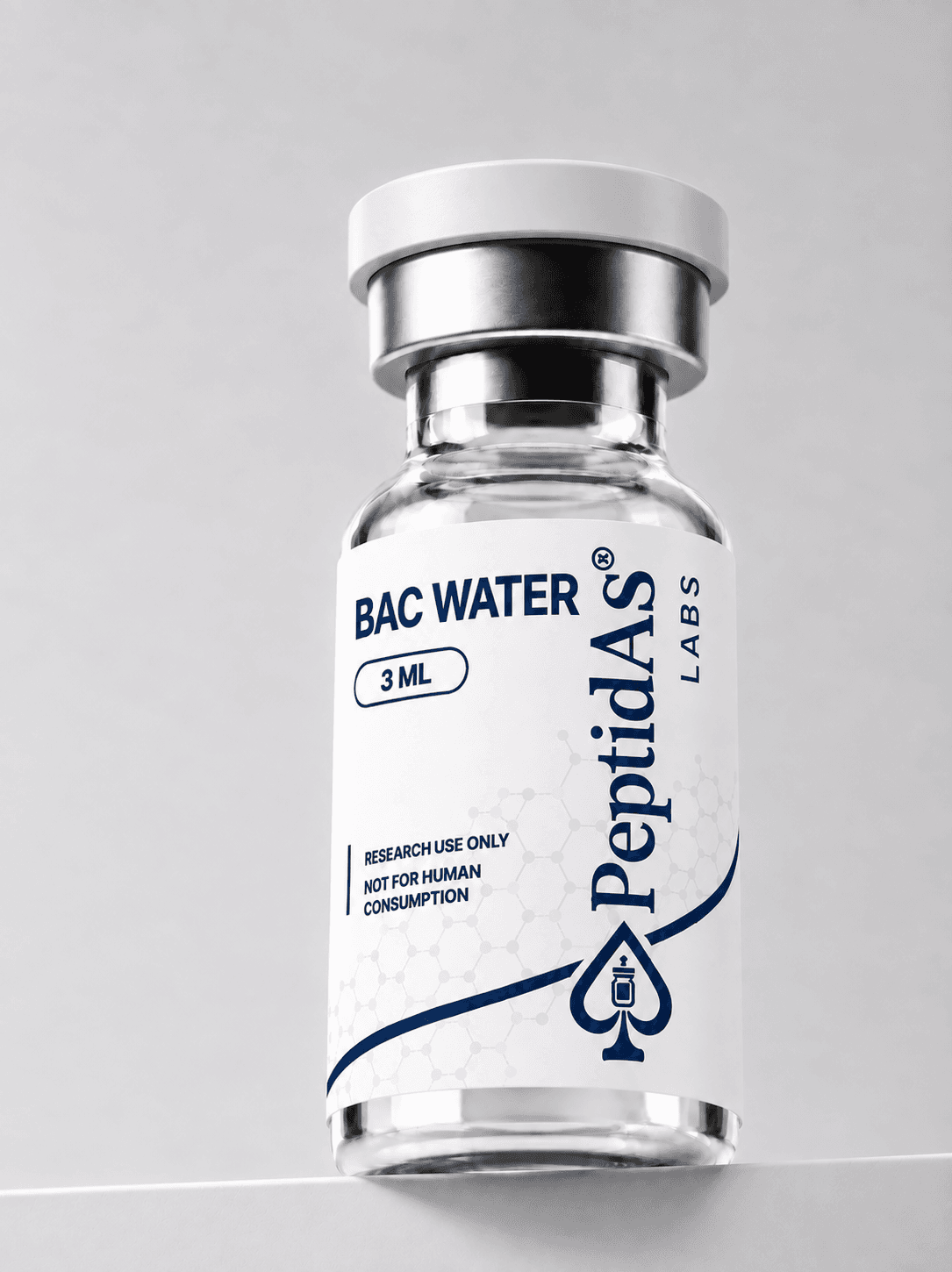
| Bacteriostatic water | Sterile water + 0.9% benzyl alcohol | Bottle opened multiple times | Several weeks when refrigerated |
| Sterile water for preparation | Sterile water without preservatives | Single-use | For immediate use |
| Diluted acetic acid | Diluted acidic solution | Peptides with low solubility at neutral pH | Depends on the peptide |
Bacteriostatic water is the default choice whenever a vial will be drawn from more than once. The benzyl alcohol it contains is a bacteriostatic agent: it prevents microbial growth between draws. Without it, a multi-draw vial becomes a culture medium.
Sterile water alone contains no preservatives. It is suitable for a vial used in a single session, not for a supply that will be drawn from over a three-week period.
Some peptides, particularly those rich in hydrophobic residues, do not dissolve well at neutral pH. A diluted acetic acid solution solubilizes them, possibly followed by dilution in the working buffer. Check the compound’s data sheet before proceeding.
How do you calculate the concentration?
The calculation fits on one line:
Concentration = mass of the vial / volume of solvent added
A 10 mg vial reconstituted with 2 mL of solvent yields a 5 mg/mL solution. The same vial with 5 mL yields 2 mg/mL.
| Mass of vial | Solvent added | Concentration obtained |
|---|---|---|
| 5 mg | 1 mL | 5 mg/mL |
| 5 mg | 2 mL | 2.5 mg/mL |
| 10 mg | 2 mL | 5 mg/mL |
| 10 mg | 5 mL | 2 mg/mL |
| 50 mg | 5 mL | 10 mg/mL |
Two common pitfalls:
- The stated mass is not always the mass of the peptide. A 10 mg vial with 80% net peptide content contains 8 mg of peptide; the rest is residual water and counterions. For a rigorous calculation of molar concentration, it is the net content that matters, not the label. This information is listed on the certificate of analysis; see our guide How to Read a Peptide Certificate of Analysis.
- A larger volume is not a waste. Diluting further makes the measurement more accurate, because any volume error has a proportionally smaller impact.
Our reconstitution calculator performs this calculation for you, based on the vial, the solvent, and the target quantity.
What is the step-by-step procedure?
- Let the vial return to room temperature. A vial taken out of the freezer causes moisture from the air to condense on the powder. Wait—do not heat it.
- Settle the powder. Some of the lyophilisate often sticks to the cap after shipping. Gently tap the vial or centrifuge it briefly.
- Disinfect both caps—the one on the peptide vial and the one on the solvent vial—with isopropyl alcohol, and let them dry.
- Measure out the volume of solvent calculated in the previous step.
- Add the solvent slowly, along the inner wall of the vial. This is the most critical step in the entire procedure. The stream must never hit the powder directly: the shear force denatures the peptide and causes the solution to foam.
- Allow it to dissolve. Most peptides dissolve on their own within a few minutes. If necessary, gently swirl the vial between your fingers in a circular motion.
- Never shake. Vigorous shaking creates an air-liquid interface that denatures and aggregates the peptide. Persistent foam is a visible sign that damage has occurred.
- Check visually. The solution must be clear. Persistent cloudiness, particles, or a sediment indicate incomplete dissolution or aggregation.
- Label the solution with the compound, concentration, and date of reconstitution. Without a date, the solution becomes unusable after a few weeks of uncertainty.
How should the resulting solution be stored?
| State | Temperature | Approximate Shelf Life |
|---|---|---|
| Lyophilized, long-term | -20 °C or lower | Months to years |
| Lyophilized, long-term | 2 to 8 °C | Weeks |
| Reconstituted | 2 to 8 °C | Days to weeks depending on the sequence |
Three rules that apply to all compounds:
- Protect from light. Some sequences are highly light-sensitive, particularly copper complexes such as GHK-Cu.
- Aliquot rather than refreeze. Each freeze-thaw cycle degrades the peptide a little more. Dividing the solution into small, single-use volumes prevents this problem.
- Use a rack, not the bottom of the refrigerator. Vials that are laid on their sides or upside down can contaminate their caps.
What are the most common mistakes?
- Shaking the vial. The number one mistake. It denatures the peptide, and nothing in the solution’s appearance reveals this once the foam has settled.
- Splashing the solvent onto the powder. Same mechanism, same consequence.
- Using non-sterile water. Tap water or non-sterile distilled water introduces microorganisms and metal ions that catalyze oxidation.
- Reconstitute a vial that is still cold. Condensation introduces uncontrolled water and skews the concentration.
- Forget to date it. An undated solution ends up in the trash as a precaution, which is the same as throwing away the vial.
- Diluting a copper complex in a buffer containing EDTA. The chelating agent binds to the copper and breaks down the complex.
Required Equipment
- A sterile reconstruction solution suitable for small volumes
- Bacteriostatic water for any vial intended for multiple samples
- A rack for storing vials upright in the refrigerator
- The reconstitution calculator to determine the volume of solvent
All consumables and equipment are available in the store.
Frequently asked questions
What is the difference between sterile water and bacteriostatic water?
Bacteriostatic water contains 0.9% benzyl alcohol, a preservative that prevents microbial growth between samples. Sterile water does not contain benzyl alcohol and is intended only for single-use vials.
Why should you never shake a bottle of peptides?
Vigorous agitation creates an air-liquid interface and shear forces that denature and aggregate the peptide. The foam is a visible sign of the problem, but the peptide remains degraded even after the foam subsides.
How long does a reconstituted solution last?
At temperatures between 2 and 8 °C, protected from light, the solution is generally stable for a period ranging from a few days to a few weeks, depending on the sequence. Aliquoting the solution prevents freeze-thaw cycles, which degrade it.
My solution is cloudy. What should I do?
Persistent cloudiness indicates incomplete dissolution or aggregation. Let the solution stand without shaking, and if the cloudiness persists, check the solvent used: some hydrophobic peptides require a dilute acidic solution rather than water.
How much solvent should be added?
It depends on the target concentration: concentration equals the mass of the vial divided by the added volume. The reconstitution calculator on the website directly calculates the volume based on your vial and the desired amount.
Sources cited
- Manning MC, Chou DK, Murphy BM, Payne RW, Katayama DS. Stability of Protein Pharmaceuticals: An Update. Pharmaceutical Research, 2010;27(4):544-575.
- Wang W. Freeze-drying and development of solid protein pharmaceuticals. International Journal of Pharmaceutics, 2000;203(1-2):1-60.
- Meyer JD, Manning MC. Hydrophobic ion pairing: altering the solubility properties of biomolecules. Pharmaceutical Research, 1998;15(2):188-193.
Compounds mentioned in this article
The research products mentioned above.
Read also
What Is a Peptide? Definition, Structure, and Use in Research
A peptide is a short chain of amino acids linked by peptide bonds. Understanding its structure, how it differs from a protein, and its lyophilized form is the starting point for any serious research.
What Is Retatrutide? An Explanation of the Triple Agonist
Retatrutide is the first peptide to simultaneously activate three metabolic receptors. This is what sets it apart from tirzepatide and semaglutide, and this is what the published literature actually reports.
What Is GHK-Cu? An Explanation of the Copper Tripeptide
Discovered in human plasma in 1973, GHK-Cu is one of the most extensively studied peptides in skin research. Its structure, its complex with copper, and what the literature actually says.