What Is Retatrutide? An Explanation of the Triple Agonist
In brief. Retatrutide, development code LY3437943, is a synthetic peptide that acts as an agonist for three receptors: GIP, GLP-1, and glucagon. This triple action distinguishes it from tirzepatide, which targets two of these receptors, and from semaglutide, which targets only one. It is currently in clinical development and has not been approved by any health authority.
What is retatrutide?
Retatrutide is a peptide analog developed by Eli Lilly under the code LY3437943. Its unique feature lies in its pharmacological profile: it binds to and activates three distinct receptors involved in energy metabolism.
- The GIP receptor (glucose-dependent insulinotropic polypeptide)
- The GLP-1 receptor (glucagon-like peptide-1)
- The glucagon receptor
Structurally, it is a peptide consisting of about 30 amino acids built on a backbone derived from GIP, carrying a fatty acid chain. This acylation allows it to bind to plasma albumin, which slows its elimination and explains the weekly dosing schedule used in clinical trials.
How does triple agonism make a difference?
The three receptors do not perform the same function, and that is the whole point of the combination.
| Receptor | Main effect studied |
|---|---|
| GLP-1 | Glucose-dependent insulin secretion, delayed gastric emptying, central satiety signal |
| GIP | Insulin secretion, action on adipose tissue, potentiation of the effect of GLP-1 |
| Glucagon | Increased energy expenditure, mobilization of hepatic reserves, and lipolysis |
The first two reduce energy intake. The third acts on energy expenditure. This is the reasoning that led to the addition of the glucagon component: acting on both sides of the energy balance rather than just one.
Glucagon receptor agonism is also what makes the molecule challenging. Activating glucagon in isolation raises blood glucose levels, which is precisely what we seek to avoid in a diabetic patient. Striking the right balance among these three actions is therefore at the heart of the design challenge.
What do the published clinical trials report?
Two Phase 2 trials were published in 2023, and they constitute the bulk of the available literature on this compound.
Obesity, New England Journal of Medicine, June 2023. A randomized Phase 2 trial involving 338 adults, conducted over 48 weeks. At the highest dose evaluated, 12 mg per week, the reported mean reduction in body weight was 24.2% at week 48. The most common adverse effects were gastrointestinal, primarily nausea, diarrhea, and vomiting, mostly mild to moderate in severity and concentrated during the dose-escalation phase.
Type 2 Diabetes, The Lancet, 2023. A 36-week Phase 2 trial reporting reductions in glycated hemoglobin and body weight in a population of patients with type 2 diabetes.
A Phase 3 program, TRIUMPH, is currently underway. To date, retatrutide has not received marketing authorization from the FDA, the EMA, or the ANSM. The figures above describe what the published scientific literature reports about a compound in development—nothing more.
Retatrutide, tirzepatide, semaglutide: what’s the difference?
This is the most frequently asked question, and it can be summarized in a table.
| Compound | Targeted receptors | Average weight loss reported in trials | Trial duration |
|---|---|---|---|
| Semaglutide 2.4 mg | GLP-1 | 14.9% | 68 weeks (STEP 1) |
| Tirzepatide 15 mg | GIP + GLP-1 | 20.9% | 72 weeks (STEP 1) |
| Retatrutide 12 mg | GIP + GLP-1 + glucagon | 24.2% | 48 weeks (Phase 2) |
| Survodutide | GLP-1 + glucagon | Under evaluation | Phase 2 and 3 |
This table does not compare drugs within the same trial. These are three separate studies, with different populations, durations, and protocols. A direct comparison of the percentages is methodologically flawed. Only a head-to-head comparative trial would allow for a conclusion, and none currently exists.
What the table does show, however, is a trend: in published trials, the addition of receptor targets is associated with more pronounced weight loss, at the cost of an adverse effect profile that requires monitoring.
How is retatrutide handled in the laboratory?
Like all acylated peptide analogs, it is delivered lyophilized and must be reconstituted before any experimental work. Three specific points:
- The fatty acid chain makes the molecule sensitive to mechanical agitation. The vial should be gently rotated; it should never be shaken.
- Once reconstituted, the solution should be stored between 2 and 8 °C, protected from light, and its stability is measured in weeks, not months.
- Repeated freeze-thaw cycles degrade the molecule. It is better to aliquot the solution than to refreeze it.
Detailed instructions can be found in our guide to reconstituting a lyophilized peptide, and the reconstitution calculator provides the solvent volume required for the target concentration.
How do you verify the quality of a retatrutide batch?
An acylated analog is more difficult to synthesize cleanly than a short peptide: coupling impurities and improperly acylated forms are common. Three pieces of information to request on the batch certificate of analysis:
- HPLC purity with the chromatogram, not just a reported number
- Identity confirmed by mass spectrometry, measured mass compared to the theoretical mass
- Net peptide content, which is not the same as purity and determines the actual concentration of your solution
Our guide How to Read a Certificate of Analysis explains each section in detail. Our batch reports are publicly available on the Certificates of Analysis page.
View the compound’s product page: Retatrutide 10 mg. Other metabolic compounds in the catalog are available in the store.
Frequently asked questions
Is retatrutide approved in France?
No. Retatrutide is a compound currently in clinical development. It has not been approved for marketing in France, the European Union, or the United States. The compounds sold by PeptidAs are intended exclusively for in vitro laboratory research.
What is the difference between retatrutide and tirzepatide?
Tirzepatide is a dual agonist of the GIP and GLP-1 receptors. Retatrutide adds a third target—the glucagon receptor—which is associated with increased energy expenditure in the models studied.
Why aren't weight-loss figures comparable across different drugs?
Because they come from different trials, with different populations, durations, and protocols. Comparing 24.2% over 48 weeks to 20.9% over 72 weeks has no statistical significance. Only a direct comparative trial could settle the matter, and no such trial exists.
How should a vial of retatrutide be stored?
Store in freeze-dried form in the freezer, protected from light. Once reconstituted, the solution should be stored at 2 to 8 °C and remains stable for several weeks. Avoid repeated cycles of freezing and thawing.
Is this compound intended for human use?
No. It is intended solely for in vitro laboratory research. It is not intended for human consumption, veterinary use, diagnosis, or treatment.
Sources cited
- Jastreboff AM, Kaplan LM, Frías JP, et al. Retatrutide, a Triple-Hormone-Receptor Agonist, for Obesity—A Phase 2 Trial. New England Journal of Medicine, 2023;389(6):514-526.
- Rosenstock J, Frias J, Jastreboff AM, et al. Retatrutide, a GIP, GLP-1, and glucagon receptor agonist, for people with type 2 diabetes: a randomized, double-blind, placebo- and active-controlled, parallel-group, phase 2 trial. The Lancet, 2023;402(10401):529-544.
- Jastreboff AM, Aronne LJ, Ahmad NN, et al. Once-Weekly Tirzepatide for the Treatment of Obesity (SURMOUNT-1). New England Journal of Medicine, 2022;387(3):205-216.
- Wilding JPH, Batterham RL, Calanna S, et al. Once-Weekly Semaglutide in Adults with Overweight or Obesity (STEP 1). New England Journal of Medicine, 2021;384(11):989-1002.
Compounds mentioned in this article
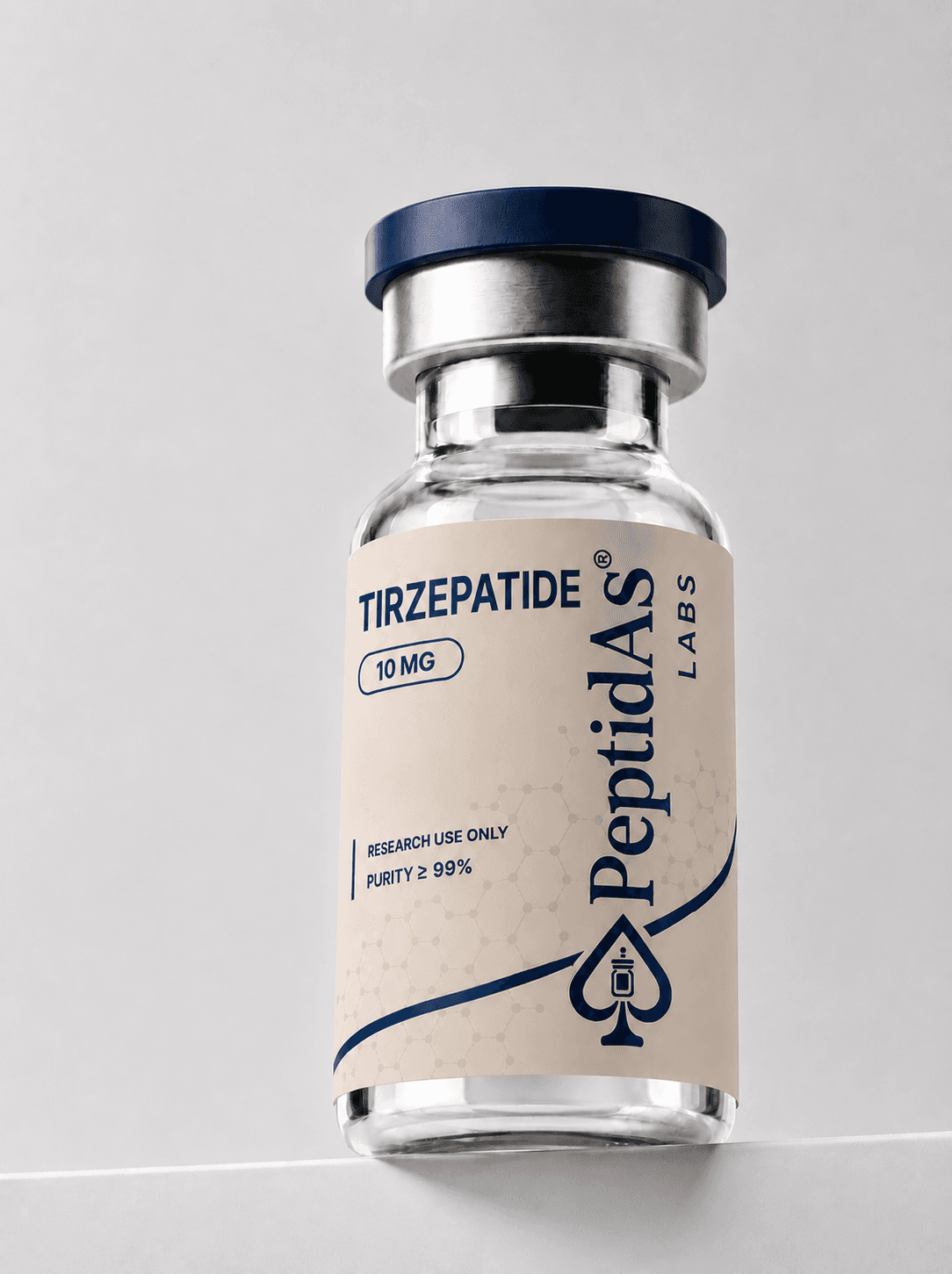
The research products mentioned above.
Read also
What Is a Peptide? Definition, Structure, and Use in Research
A peptide is a short chain of amino acids linked by peptide bonds. Understanding its structure, how it differs from a protein, and its lyophilized form is the starting point for any serious research.
What Is GHK-Cu? An Explanation of the Copper Tripeptide
Discovered in human plasma in 1973, GHK-Cu is one of the most extensively studied peptides in skin research. Its structure, its complex with copper, and what the literature actually says.
How to Reconstitute a Lyophilized Peptide in the Laboratory
Dissolving a lyophilized peptide is the step where the most batches are lost. Choosing the solvent, calculating the concentration, proper procedures, and mistakes that ruin a vial.