What Is GHK-Cu? An Explanation of the Copper Tripeptide
In a nutshell. GHK-Cu is the complex formed between a tripeptide—glycyl-L-histidyl-L-lysine—and a copper(II) ion. Isolated from human plasma in 1973, it is studied in vitro for its role in collagen synthesis and extracellular matrix repair. Its plasma concentration declines with age.
What is GHK-Cu?
GHK is a tripeptide, meaning a chain of only three amino acids: glycine, histidine, lysine. Its molecular weight is approximately 340 daltons, making it a very small molecule by peptide standards.
Its distinctive feature is its affinity for copper. The histidine residue, with the nitrogen of its imidazole ring, and the free amine end of the glycine together form a coordination site that binds a copper(II) ion with high affinity. The resulting complex, denoted GHK-Cu, has a molecular weight of approximately 404 daltons.
It is this complex, and not the naked peptide, that possesses the biological activity described in the literature. Copper is not an additive; it is part of the active molecule.
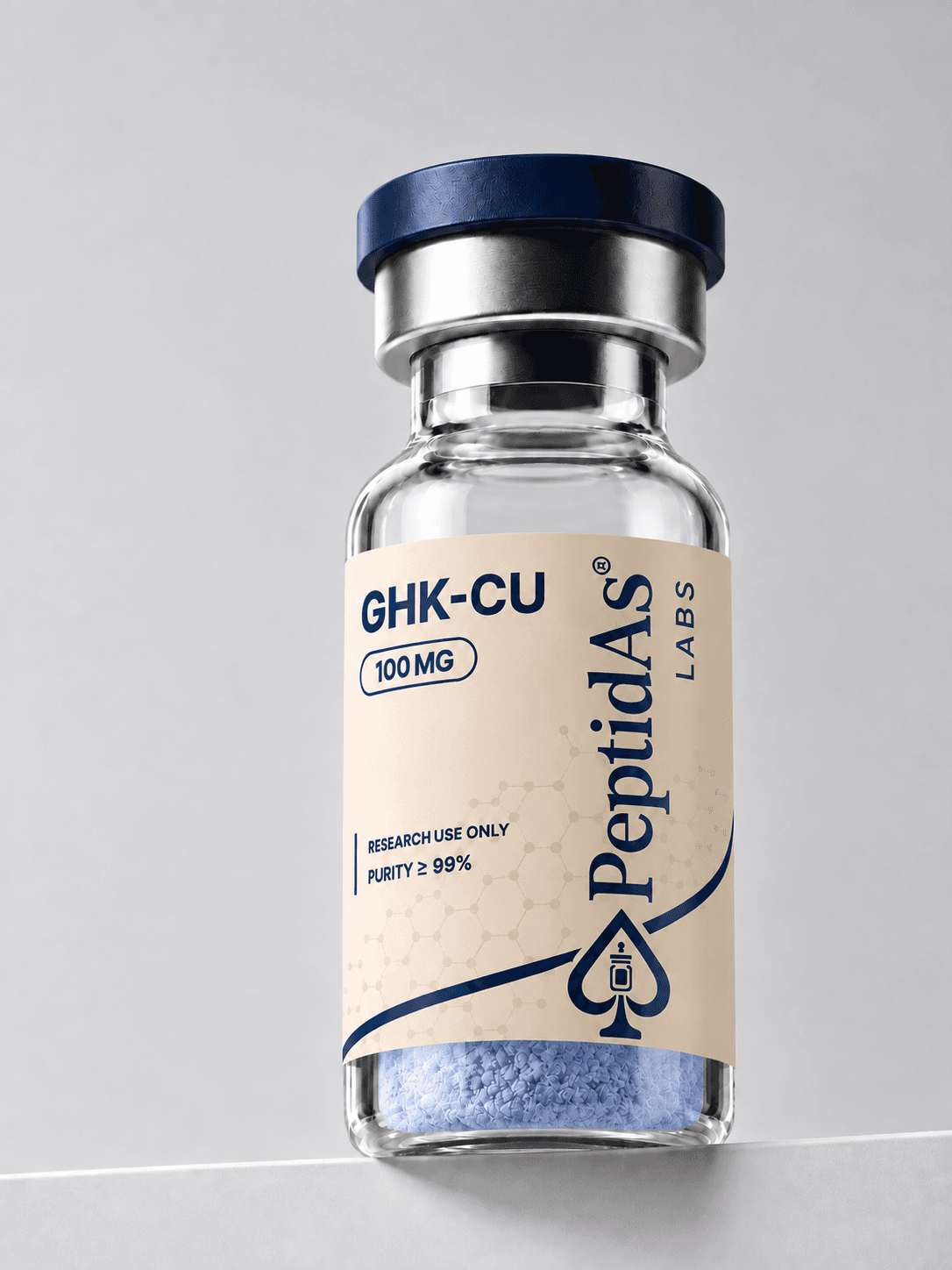
Immediate practical implication: a properly reconstituted GHK-Cu solution is blue. This color stems from the electronic transition of the coordinated copper ion. A colorless solution indicates either the absence of copper or a product that is not what it claims to be.
How was GHK-Cu discovered?
In 1973, Loren Pickart was investigating a strange observation: aged human liver tissue, when cultured with albumin from young subjects, began to behave like young tissue. He searched for the responsible factor and isolated a small active molecule from human plasma. This was GHK.
Subsequent research established that the plasma concentration of GHK declines with age: around 200 nanograms per milliliter at age twenty, compared to about 80 nanograms per milliliter at age sixty. This decline is one of the factors that has directed research toward a role in tissue repair.
What do studies on GHK-Cu show?
The literature on GHK-Cu is extensive, dating back many years, and consists primarily of in vitro studies or animal models. The most well-documented areas of research are:
- Extracellular matrix synthesis. Stimulation of collagen, elastin, proteoglycan, and glycosaminoglycan production by cultured fibroblasts.
- Modulation of gene expression. An analysis published in 2015, based on the Broad Institute’s Connectivity Map database, reports that GHK alters the expression of several thousand human genes, shifting the expression profile toward that of healthier tissues.
- Antioxidant and anti-inflammatory activity in cellular models.
- Wound healing. Accelerated wound closure in several animal models.
- Angiogenesis. Stimulation of new blood vessel formation in experimental models.
Two valid methodological caveats must be noted. First, a large portion of this body of research comes from a single group of researchers, which limits the independence of replication studies. Second, a result obtained in cultured fibroblasts does not automatically translate to a whole organism. The literature describes a documented mechanism, not established clinical efficacy.
GHK-Cu and AHK-Cu: What’s the Difference?
Both are copper-complexed tripeptides, and they are often confused.
| GHK-Cu | AHK-Cu | |
|---|---|---|
| Sequence | Glycine, histidine, lysine | Alanine, histidine, lysine |
| Origin | Isolated from human plasma, 1973 | Synthetic analog |
| Primary area of study | Extracellular matrix, collagen, wound healing | Hair follicle, microvascularization |
| Color in solution | Blue | Blue |
Replacing glycine with alanine changes only a single group, but is sufficient to alter the activity profile described in the studies. See the GHK-Cu 50 mg product sheet.
How should GHK-Cu be handled in the laboratory?
The copper complex requires precautions that ordinary peptides do not.
- Protection from light. The complex is light-sensitive. Use an amber vial or opaque packaging, and return it to cold storage immediately after handling.
- Do not shake vigorously. As with any peptide, gently swirl the vial; do not shake it.
- Beware of chelating agents. Anything that chelates copper—starting with EDTA—dissociates the complex and renders it inactive. Check the composition of your buffers before diluting.
- pH. The stability of the complex depends on the pH of the medium. A pH that is too acidic protonates the coordination sites and releases the copper.
- Storage. Store the lyophilized product in the freezer, protected from light. Once reconstituted, store at 2–8 °C in aliquots to avoid freeze-thaw cycles.
The general procedure is detailed in our guide to reconstituting a lyophilized peptide, and the reconstitution calculator provides the volume of solvent to add.
How to Verify a Batch of GHK-Cu?
Beyond the three standard data points—HPLC purity, mass spectrometry identity, and net peptide content—there is one aspect specific to this compound: copper content. GHK sold as GHK-Cu but with insufficient copper complexation is not the same product, and nothing in a chromatographic purity measurement reveals this.
The visual test is quick and free: reconstitute the solution and check the color. It should be distinctly blue.
As for the rest, our guide How to Read a Certificate of Analysis explains each section of a batch report, and all of our certificates are available on the Certificates of Analysis page.
Frequently asked questions
Why is my GHK-Cu solution blue?
The blue color comes from the copper(II) ion coordinated to the tripeptide. This is the expected indication of a properly formed complex. Conversely, a colorless solution should raise concerns about the actual copper content of the batch.
What is the difference between GHK and GHK-Cu?
GHK is the tripeptide glycyl-histidyl-lysine on its own. GHK-Cu is the same peptide complexed with a copper(II) ion. It is the complex, not the unbound peptide, that exhibits the activity described in the literature.
Can GHK-Cu be diluted in any buffer?
No. Any chelating agent—EDTA in particular—binds to copper and dissociates the complex. A pH that is too acidic produces the same effect. Check the composition of your buffer before diluting it.
Is GHK-Cu photosensitive?
Yes. The compound degrades when exposed to light. Store the vial in its opaque packaging or in an amber vial, and minimize exposure time when handling it.
Is this compound intended for human use?
No. It is intended solely for in vitro laboratory research. It is not intended for human consumption, veterinary use, diagnosis, or treatment.
Sources cited
- Pickart L, Margolina A. Regenerative and Protective Effects of the GHK-Cu Peptide in Light of New Genetic Data. International Journal of Molecular Sciences, 2018;19(7):1987.
- Pickart L, Vasquez-Soltero JM, Margolina A. GHK Peptide as a Natural Modulator of Multiple Cellular Pathways in Skin Regeneration. BioMed Research International, 2015;2015:648108.
- Pickart L, Thaler MM. A tripeptide in human serum that prolongs the survival of normal liver cells and stimulates growth in neoplastic liver tissue. Nature New Biology, 1973;243(124):85-87.
Compounds mentioned in this article
The research products mentioned above.
Read also
What Is a Peptide? Definition, Structure, and Use in Research
A peptide is a short chain of amino acids linked by peptide bonds. Understanding its structure, how it differs from a protein, and its lyophilized form is the starting point for any serious research.
What Is Retatrutide? An Explanation of the Triple Agonist
Retatrutide is the first peptide to simultaneously activate three metabolic receptors. This is what sets it apart from tirzepatide and semaglutide, and this is what the published literature actually reports.
How to Reconstitute a Lyophilized Peptide in the Laboratory
Dissolving a lyophilized peptide is the step where the most batches are lost. Choosing the solvent, calculating the concentration, proper procedures, and mistakes that ruin a vial.